
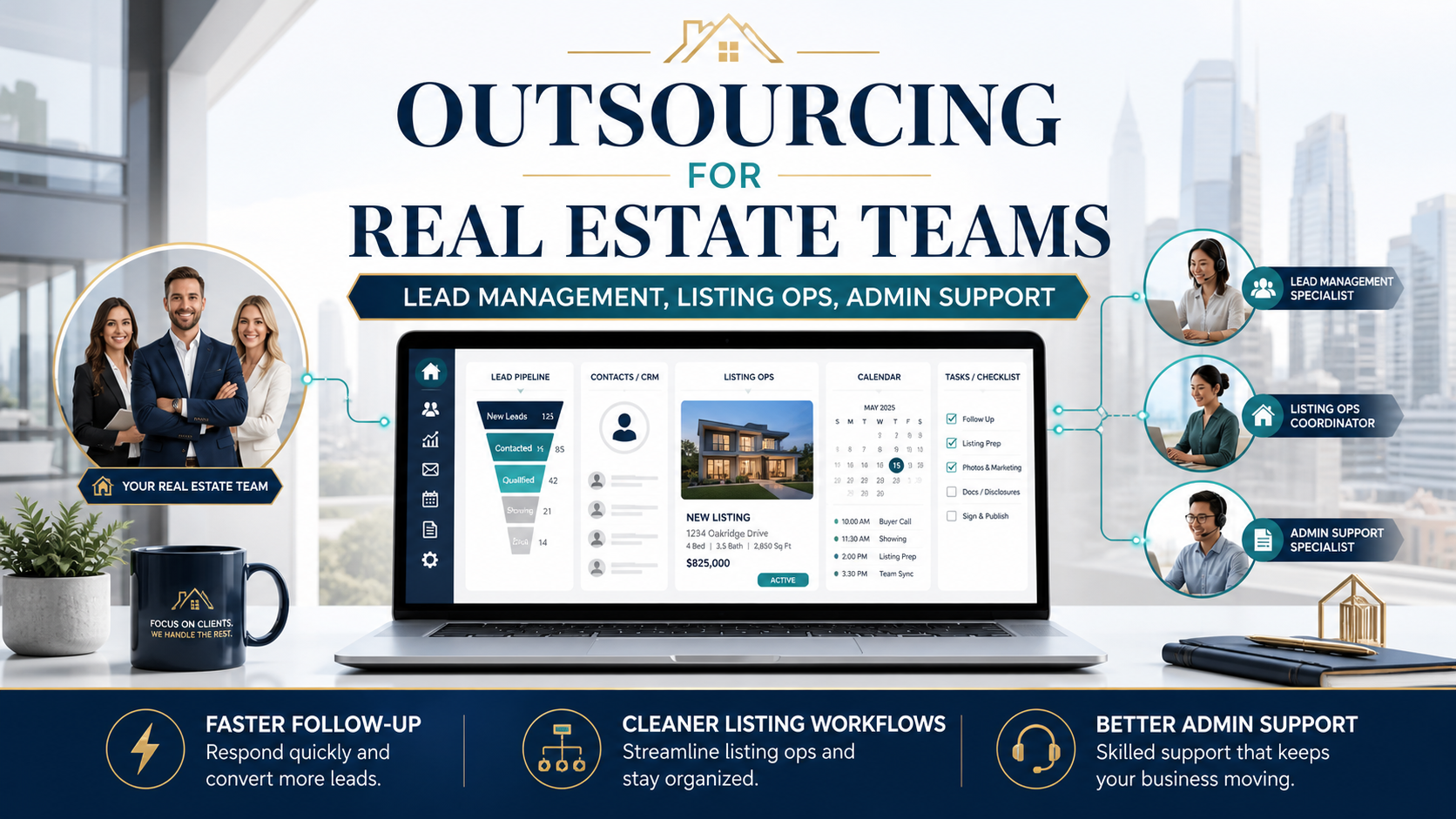
Real estate teams grow faster when agents can stay focused on sales while the operational work stays organized behind the scenes. This blog explains how outsourcing lead management, listing operations, and admin support can help reduce missed follow-ups, improve workflow consistency, and create a smoother client experience without adding more internal pressure.
Real estate teams usually feel pressure in two places at once. They need to keep new business moving, and they need to keep existing deals organized. That means the work is not only about selling. It is also about follow-up, paperwork, vendor coordination, timelines, client communication, and daily admin. Real estate management guidance regularly points back to the same idea: strong organization and a workable management structure help teams use time better and protect the bottom line. Hamedia’s core positioning also fits this well because the company focuses on combining talent, AI, and strategy to improve operations and growth.
That is why outsourcing can work so well for real estate teams when it is done properly. It is not about removing the agent from the relationship. It is about creating a support layer behind the agent so the pipeline, the listing process, and the admin work do not fall apart as volume grows. Hamedia’s approach page says the process starts with understanding goals, studying workflows, and then blending people and AI automation around the places where support matters most. That is the kind of operating model that makes outsourcing feel useful instead of disconnected.
Most real estate teams do not outsource because they want to be less involved. They outsource because too much of the day gets pulled into repetitive work that keeps agents away from prospecting, client strategy, negotiations, and closings. Real estate admin guidance describes assistants as the backbone of the operation because they handle paperwork, scheduling, coordination, and client communication that keep the business moving. Listing operations guidance makes a similar point by explaining that every hour spent on MLS entry, photographer scheduling, or vendor coordination is an hour not spent winning the next client.
When outsourcing is structured well, it creates leverage. The sales side of the business stays focused on revenue activity, while the operational side becomes more consistent, easier to track, and less dependent on one overwhelmed person remembering everything. That separation between sales activity and operational execution is one of the clearest patterns in real estate team growth guidance.
Lead management is one of the first areas real estate teams should look at because it is both repetitive and highly sensitive to timing. Real estate lead management guidance describes the process as attracting, nurturing, and converting leads from initial contact through client conversion, while organized templates, checklists, and software help keep prospects from falling through the cracks. Separate lead-response research also shows that contacting a lead within five minutes can dramatically improve qualification and contact rates compared with waiting longer.
That makes lead management a strong outsourcing category because many of the tasks are process-driven. A remote support team can route inbound inquiries, send first acknowledgments, update the CRM, tag the lead source, book appointments, trigger follow-up sequences, and keep notes clean while the agent focuses on the actual sales conversation. Real estate lead management guidance specifically highlights staying organized, using templates and checklists, and maintaining a clear process so next steps do not get lost. Hamedia’s virtual assistant service also supports CRM updates, customer support, appointment scheduling, and reporting tasks that fit naturally into this workflow.
A practical handoff often looks like this: the outsourced team handles speed, consistency, and documentation, while the agent handles qualification depth, relationship-building, and closing. That model works especially well because speed-to-lead matters, but so does human connection. If the operational side can respond quickly and keep the pipeline organized, the licensed team has more room to focus on the parts of the job that really require them.
If your real estate team needs structured support around inbox follow-up, CRM updates, appointment setting, lead nurturing, and recurring admin work, this is a natural place to point readers toward Hamedia’s service offering. If you need reliable virtual assistants supported by AI-enhanced workflows and trained operational oversight, check this page.
A lot of teams underestimate listing operations because they treat it like light admin. In practice, listing ops is closer to project management. Real estate listing support guidance says it is a mistake to think listing support is only about data entry. It describes the work as total project management with administrative compliance, property preparation, media management, marketing logistics, vendor coordination, and reverse timeline planning from go-live date back through staging, repairs, cleaning, photos, and MLS prep.
That means listing operations can include gathering signed listing agreements, handling disclosures, collecting HOA documents, coordinating cleaners, landscaping, and handyman work, booking photographers and videographers, reviewing media assets, handling MLS input, arranging signs and lockboxes, and keeping all of the third-party timing aligned. When a team does not assign ownership here, listing launches become stressful, rushed, and inconsistent. When a team does assign ownership, the process becomes calmer and easier to repeat.
This is also where outsourcing creates real leverage for agents. The agent should still own pricing strategy, seller relationship, and negotiation, but the behind-the-scenes execution can be handled by a trained support layer. Listing operations guidance makes the case clearly: separating sales activities from operational tasks is how teams grow without burning out.
Once a property moves under contract, the checklist gets even longer. Real estate transaction coordination guidance includes collecting deposits, reviewing and uploading agreements, tracking contingencies and deadlines, collecting disclosures, coordinating inspections, communicating with lenders, confirming walkthroughs, managing closing details, handling post-closing utility transfer tasks, and sending satisfaction surveys. It also recommends using one checklist as the single source of truth so everyone touching the deal stays aligned.
That matters because real estate deals usually do not break from one massive mistake. They break from small missed details, unclear communication, and timeline slippage. When one person owns the tracking, reminders, uploads, and workflow visibility, the deal becomes much easier to manage. It is also easier for the client to feel like the team is organized, even when a lot is happening behind the scenes.
Admin support sounds basic until it is missing. Real estate admin guidance describes the role as the behind-the-scenes engine that keeps the office running smoothly, including calls, emails, scheduling, paperwork, client communication, database updates, listing updates, transaction tracking, and coordination with inspectors, appraisers, lenders, and other parties. These tasks may not close the deal by themselves, but they make it much easier for the team to operate professionally.
This is one reason admin support is such a strong outsourcing category. A remote assistant can manage inboxes, prioritize messages, coordinate calendars, prepare documents, take notes, update CRM records, handle customer communication, and support reporting. Hamedia’s virtual assistant page lines up closely with that kind of work, including email support, scheduling, data entry, document preparation, answering calls, chats, and emails, updating CRM systems, and producing research or reporting outputs. It also specifically notes finance and real estate support use cases such as mortgage processing, lead nurturing, and contract prep.
The value here is not only task completion. It is consistency. When admin support is owned, client messages get answered faster, calendars stay cleaner, databases stay more accurate, and agents stop carrying small operational tasks in their heads all day. That makes the whole team feel less reactive.
The smartest place to start is usually with the tasks that repeat daily, do not require licensed negotiation, and are easy to standardize. For many real estate teams, that means inbound lead handling, CRM updates, appointment scheduling, email triage, listing prep coordination, document tracking, follow-up reminders, and transaction checklist management. Guidance on real estate lead management, listing operations, and transaction coordination all point toward the same operational pattern: use process and checklists to standardize the repeatable work so the team does not rely on memory alone.
That does not mean outsourcing should start with everything at once. A smaller and cleaner rollout usually works better. Start with one lane, prove the workflow, define response times and ownership, then expand into the next lane. Hamedia’s approach page supports that logic by emphasizing learning the client’s goals and processes first, then designing support around the places where it matters most.
Real estate outsourcing works best when the business treats it like an operating model, not just a staffing shortcut. That means clear roles, written workflows, one source of truth, tracked response times, and a regular reporting rhythm. Real estate team management guidance recommends organization and adaptive structure. Transaction coordination guidance recommends a shared checklist. Lead management guidance recommends templates, checklists, and software-supported follow-up. Together, those sources point to one conclusion: the cleaner the process, the better the outsourced support performs.
If your team also needs more connected communication across lead intake, email, phone, chat, and follow-up touchpoints, Hamedia’s omnichannel support page is another natural reference. It focuses on connected conversations, centralized tracking, KPI visibility, and faster response times across channels, which fits especially well for teams trying to tighten lead response and client communication.
For real estate teams, outsourcing is most useful when it supports the parts of the business that are operationally heavy but still critical to client experience. Lead management keeps opportunity from leaking. Listing ops keeps launches organized. Admin support keeps the entire office moving. When those areas are supported well, agents get more time for the work only they can do, and the business becomes easier to scale without becoming chaotic.
Valerie Vince Cruz is a thought leader in AI-enhanced outsourcing and business operations. With years of experience helping companies scale efficiently, they share insights on the latest trends and best practices in the industry.
Get in touch with our team and we'll help you find the right solution.
A strong check-in cadence helps remote teams stay aligned without turning every day into nonstop meetings. This blog explains how daily, weekly, and monthly check-ins each serve a different purpose, from surfacing blockers and managing workload to reviewing progress, improving communication, and keeping remote operations organized over time.

A remote team scorecard helps you measure performance with more clarity and less guesswork. This blog explains how to build role-based KPIs for virtual assistants, technical support, sales, marketing, operations, and managers so you can track output, quality, responsiveness, and results in a way that actually supports remote team growth.

Protecting remote teams does not have to be complicated. This blog breaks down a simple data protection policy businesses can implement to secure devices, manage access, reduce human error, and protect sensitive information across remote workflows. It also covers practical steps for stronger passwords, safer file sharing, phishing awareness, and better support systems for distributed teams.