

A remote team scorecard helps you measure performance with more clarity and less guesswork. This blog explains how to build role-based KPIs for virtual assistants, technical support, sales, marketing, operations, and managers so you can track output, quality, responsiveness, and results in a way that actually supports remote team growth.
Managing a remote team gets much easier when everyone knows what success looks like. That is where a scorecard helps. A remote team scorecard is simply a clear way to track performance by role, using a small group of useful KPIs instead of relying on guesswork, feelings, or random check-ins. The goal is not to monitor people every minute. The goal is to create visibility, accountability, and clarity so each person knows what matters most in their role. Asana defines KPIs as key performance indicators that show how work is performing, and it also explains that leading indicators help predict success while lagging indicators measure results after the fact.
A remote team scorecard matters even more when your business is spread across locations, time zones, or outsourced support functions. Gallup’s guide on hybrid and remote teams says success in distributed workplaces depends less on location and more on management quality, clear expectations, and intentional team design. That is exactly why scorecards work well. They help turn expectations into something visible and measurable instead of leaving performance open to interpretation.
This is also a strong fit for Hamedia Agency’s audience. Hamedia’s website says it combines talent, AI, and strategy to provide outsourcing and digital services tailored to business needs, while its approach page says it helps businesses work faster, smarter, and more efficiently by combining artificial intelligence with human expertise. If your business is already thinking about remote staffing, virtual assistants, technical support, or AI-supported workflows, a scorecard is one of the best ways to keep those teams aligned and measurable.
A good scorecard should answer a few simple questions. What is this role responsible for? What numbers show whether the work is being done well? What numbers show whether the work is improving? How often should performance be reviewed? A scorecard should make the role easier to manage, not harder. If it becomes too complicated, nobody will use it consistently. Asana recommends keeping scorecards focused and says that 5 to 10 key metrics per team is often a good range because too many metrics dilute focus.
That is why the best scorecards usually mix leading and lagging KPIs. Leading KPIs help you see whether the team is doing the right things now, such as response speed, task completion, follow-up rate, or backlog age. Lagging KPIs show the outcome later, such as revenue, customer satisfaction, closed tickets, or error rate. Atlassian and Asana both make this same point in slightly different ways. A balanced scorecard should not look only at results after the fact. It should also show whether the daily behavior is moving in the right direction.
A scorecard also works better when it stays separate from broader goal-setting. Atlassian explains that KPIs measure ongoing performance against business objectives, while OKRs are a goal-setting framework used to drive change and improvement over a set period. In simple terms, KPIs show whether the engine is running well. OKRs help you push the business toward a bigger target. Your remote team scorecard should mainly focus on KPIs, even if those KPIs support larger quarterly goals.
One of the biggest mistakes businesses make is choosing metrics before they fully define the role. If a person is not clear on what they own, the scorecard will only create confusion. The scorecard should come after the responsibilities are clear, not before. Gallup’s remote work guidance stresses the importance of clear expectations and intentional team design, and that applies directly here. Before you measure a role, define the outputs, the handoff points, and the standards.
That is also why process matters so much. Atlassian’s work management guide describes work management as a system that provides visibility and fosters collaboration across tasks and teams. If your workflows are scattered, your scorecard will be scattered too. The cleaner the process, the cleaner the metrics.
Source URL: https://www.atlassian.com/blog/work-management/guide-to-work-management
If your business needs help building structured support around recurring admin work, scheduling, inbox support, CRM updates, and other daily tasks, this is a good place to naturally point readers toward a service page. If you need reliable virtual assistants supported by structured workflows and AI-backed support, check this page.
A simple remote team scorecard usually has six parts. It has the role name, the main responsibilities, the 5 to 8 KPIs that matter most, the target for each KPI, the reporting frequency, and the person who reviews it. That is enough for most businesses. You do not need a complicated dashboard at the beginning. You need a format that can actually be reviewed weekly or monthly. Asana’s KPI template guidance also reinforces that useful KPI tracking should connect goals, measurable metrics, benchmarks, owners, and reporting intervals.
Another practical rule is this: measure output, quality, and responsiveness, not just activity. Activity alone is not enough. A remote employee can be very busy and still be ineffective. A better scorecard tracks whether the work gets done, whether it is accurate, and whether it moves fast enough to support the business.
For a virtual assistant, the scorecard should focus on execution, accuracy, organization, and responsiveness. Good KPIs often include task completion rate, on-time completion rate, calendar or scheduling accuracy, inbox response time, CRM update accuracy, documentation completeness, and follow-up completion rate. If the VA handles recurring support, you can also track turnaround time for assigned tasks and the percentage of tasks completed without rework. These metrics tell you whether the role is removing work from the business or creating extra cleanup.
Hamedia’s virtual assistant page is useful here because it shows the kinds of tasks VAs often handle in real workflows, including appointment scheduling, CRM and project management updates, research, reporting, and operational support. The page also says Hamedia’s VAs are backed by AI automation, AI QA, AI knowledge base support, and AI analytics, which makes a scorecard even more effective because quality and trends can be reviewed more consistently.
A simple way to read a VA scorecard is this. If task completion is high but rework is also high, the VA may be working fast but not accurately. If response time is strong but documentation is weak, the role may be reactive but not organized. This is why scorecards should show more than one type of metric.
Technical support scorecards should focus on speed, resolution quality, backlog health, and customer experience. Strong KPIs often include first response time, resolution time, ticket backlog, reopened ticket rate, escalation rate, customer satisfaction score, and first-contact resolution rate. These show whether the team is helping users quickly and whether the help is actually solving the issue.
Hamedia’s technical support page already highlights metrics that fit naturally into this type of scorecard, including average response time, reduced ticket backlog, and higher satisfaction. It also says its support combines human care with AI efficiency and offers 24/7 help. Those claims make the page a natural internal destination for readers who are actively thinking about remote support performance.
If your business needs dependable technical support for customers or internal users, and you want a setup that can actually be measured by response time, backlog health, and service quality, this page is worth linking directly in the article.
A customer support scorecard should track service quality and consistency across channels. Useful KPIs include first response time, average handle time, resolution time, customer satisfaction, QA score, escalation rate, and ticket volume handled per agent. If the team handles chat, email, and social media, it can also help to break response times down by channel because speed expectations are not always the same everywhere.
This is where leading and lagging indicators matter. Response time and QA score are leading signals because they show whether the team is working in a way that should produce better outcomes. Customer satisfaction and churn-related support trends are lagging signals because they reflect what customers felt after the interaction. Keeping both on the scorecard gives you a fuller view.
Remote sales and telemarketing roles need a scorecard that goes beyond raw call volume. Activity matters, but outcomes matter more. Good KPIs often include contact attempts, connection rate, qualified conversations, appointments set, follow-up completion rate, conversion rate, no-show rate for meetings booked, and pipeline value influenced. If the role is early-stage outbound, you may also want to track list quality and decision-maker identification rate.
This kind of scorecard helps businesses avoid a very common mistake, which is praising high activity even when that activity is not producing movement. A rep can make a large number of calls and still not create quality conversations. A better scorecard shows whether effort is turning into real progress.
For remote SEO and content roles, the scorecard should connect production to performance. Useful KPIs often include content pieces completed on time, optimization accuracy, internal link implementation, page update completion, keyword movement for tracked pages, click-through rate, organic sessions, leads influenced, and conversion actions from content. Some are operational, and some are performance-based. You need both.
For example, publishing four optimized blog posts on time is useful, but it is still only activity. If those posts are not indexed, not ranking, and not supporting business goals, the scorecard is missing something. This is where leading metrics like content output and on-page completion should sit beside lagging metrics like traffic growth and conversions.
Operations and coordination roles often hold remote teams together, so their scorecard should focus on flow, follow-through, and visibility. Good KPIs can include project deadline hit rate, task aging, process compliance, reporting accuracy, issue escalation time, meeting follow-up completion, and documentation completeness. These roles are not always measured well because their contribution is often indirect, but that does not mean it should be ignored.
Atlassian’s work management guidance is helpful here because it frames work management around visibility, collaboration, and task flow. That is exactly what operations roles support. If the team is constantly missing handoffs, losing updates, or following inconsistent processes, the scorecard should show it.
Managers need scorecards too. A remote manager should not be judged only by whether the team seems busy. Strong manager KPIs often include team SLA attainment, team quality score, coaching completion rate, issue escalation speed, employee retention, attendance reliability, and team engagement or pulse survey trend when available. Gallup’s remote work guidance points to management quality, trust, and clarity as major drivers of remote team success, which is why manager scorecards should include both operational results and team health.
This matters because remote managers create the environment that everyone else works inside. If coaching is inconsistent, standards are unclear, and blockers are ignored too long, the rest of the scorecards will start to drift. The manager scorecard should help spot that early.
Most remote team scorecards work best with a weekly review for execution metrics and a monthly review for trend metrics. Weekly reviews keep people focused on what needs attention now. Monthly reviews help you spot patterns, coaching needs, staffing gaps, and process issues. If you only review quarterly, you usually find problems too late. If you review too often, people start chasing noise instead of trends.
A scorecard should also be visible. It does not need to be public to everyone in the company, but the role owner and manager should both know where it lives and how it is read. Visibility is one of the reasons work management systems matter so much in remote environments.
The first mistake is using too many metrics. When a role has fifteen or twenty KPIs, nobody knows what matters most. The second mistake is tracking only activity. Activity helps, but output and quality matter more. The third mistake is using the same scorecard for very different roles. A VA, a support rep, and a sales rep should not be judged by the same model because they create value in different ways.
Another mistake is forgetting context. A scorecard should support coaching, not replace it. If performance drops, the number should start a conversation. It should not be the only conversation. Good managers use scorecards to create clarity, find patterns, and improve decisions.
A remote team scorecard does not need to be fancy to be effective. It needs to be clear, role-based, and reviewed consistently. When it is built well, it helps remote teams stay aligned, helps managers coach better, and helps the business see what is actually improving. The best scorecards balance leading and lagging indicators, stay focused on the few numbers that matter most, and connect daily work to real business outcomes.
If you are building a remote team and want support with virtual assistants, technical support, or AI-enhanced workflows that are easier to measure and manage, Hamedia Agency has several next steps readers can explore.
Valerie Vince Cruz is a thought leader in AI-enhanced outsourcing and business operations. With years of experience helping companies scale efficiently, they share insights on the latest trends and best practices in the industry.
Get in touch with our team and we'll help you find the right solution.
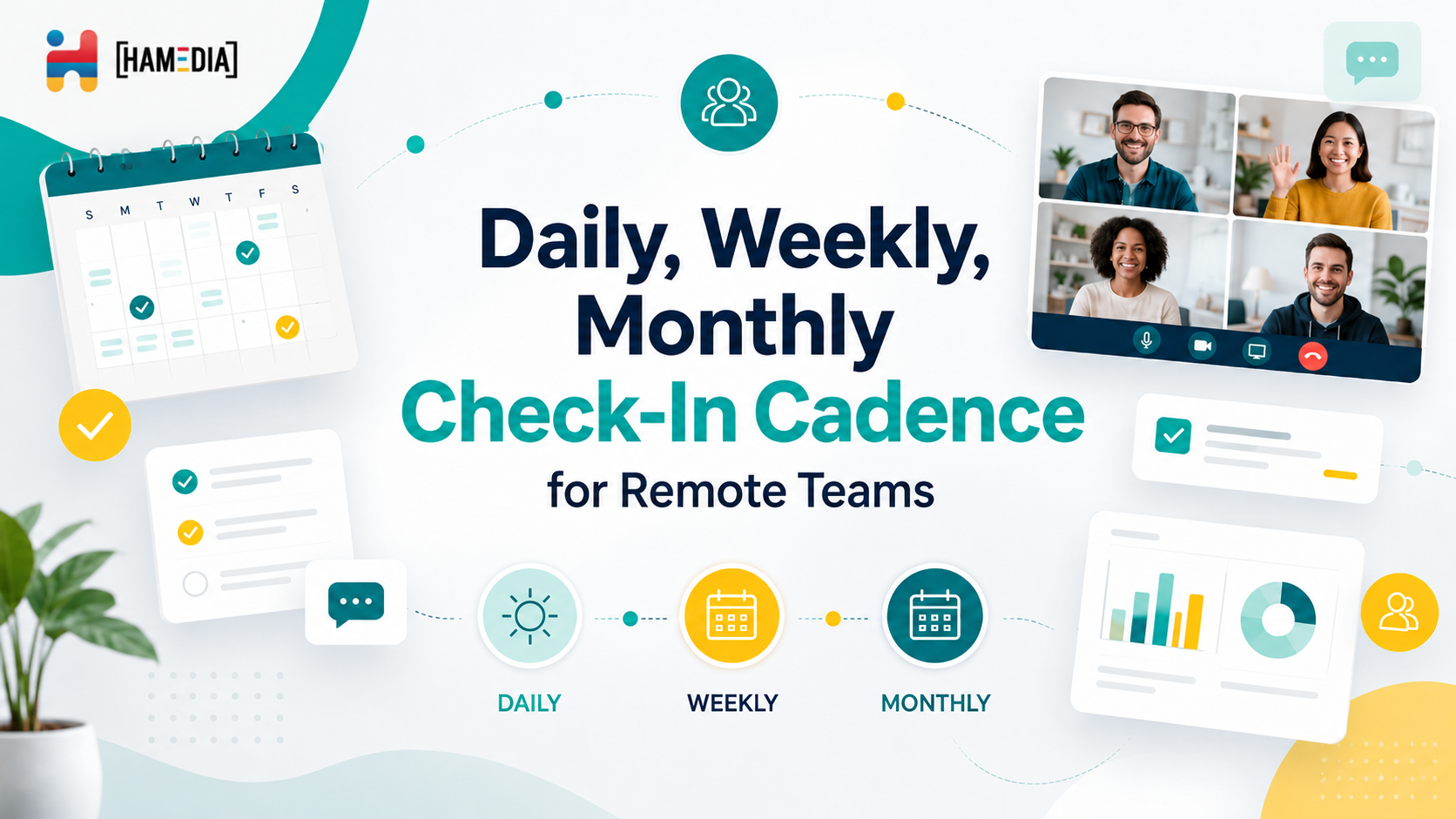
A strong check-in cadence helps remote teams stay aligned without turning every day into nonstop meetings. This blog explains how daily, weekly, and monthly check-ins each serve a different purpose, from surfacing blockers and managing workload to reviewing progress, improving communication, and keeping remote operations organized over time.

Real estate teams grow faster when agents can stay focused on sales while the operational work stays organized behind the scenes. This blog explains how outsourcing lead management, listing operations, and admin support can help reduce missed follow-ups, improve workflow consistency, and create a smoother client experience without adding more internal pressure.
Protecting remote teams does not have to be complicated. This blog breaks down a simple data protection policy businesses can implement to secure devices, manage access, reduce human error, and protect sensitive information across remote workflows. It also covers practical steps for stronger passwords, safer file sharing, phishing awareness, and better support systems for distributed teams.