
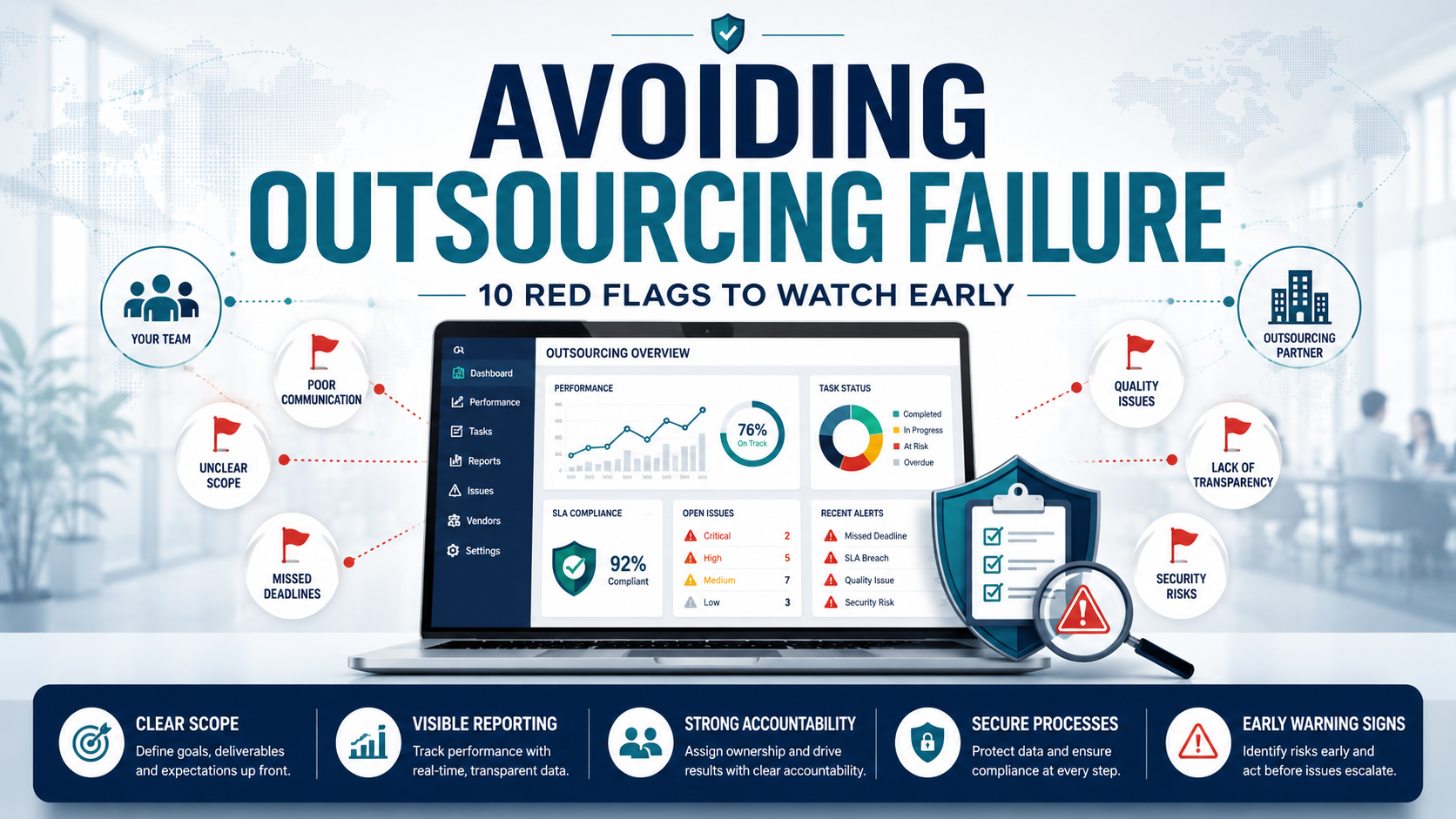
Outsourcing problems rarely begin with one major failure. They usually start with smaller warning signs that are easy to ignore at first. This blog outlines 10 early red flags businesses should watch for, from vague scope and weak communication to poor reporting, repeated rework, and unclear accountability, so teams can spot problems sooner and avoid bigger outsourcing failures later.
Outsourcing usually does not fail all at once. It starts failing in smaller ways first. A few missed updates. A little confusion around ownership. A report that feels vague. A task that needed rework but should not have. By the time the relationship feels clearly broken, the early warning signs were often there for weeks or months. Risk and supplier-management guidance consistently recommends setting early warning signals, clear accountability, and regular review points so small issues can be caught before they become larger operational problems.
That is why businesses need to watch outsourcing relationships early, not just evaluate them after a major problem. The most useful question is not “Is this partner good or bad?” The better question is “Are we seeing the signs of a healthy operating relationship, or are we already seeing drift?” Hamedia’s own positioning fits this well because its site emphasizes AI-powered outsourcing that feels like an in-house team, supported by clear workflows, visible metrics, QA, and long-term partnership design rather than loose task handoffs.
Most outsourcing problems do not come from one dramatic event. They come from weak setup, unclear expectations, inconsistent communication, missing controls, or declining trust. Partnership and supplier-management guidance often points to the same pattern: when strategy, service expectations, governance, and accountability are not clearly defined, the relationship starts to slip long before anyone formally says it is failing.
That is important because many businesses keep pushing through warning signs for too long. They assume the provider will improve once they “get more settled,” or they keep making excuses because changing vendors feels painful. But catching the red flags early is often what protects the relationship, or at least protects the business from spending too much time and money on a bad fit.
One of the earliest signs of future trouble is that nobody can explain the scope in a clean way. If you ask what the provider owns, what stays internal, what the deliverables are, and how success is measured, the answers should be easy to understand. If those answers still feel fuzzy after onboarding, that is a real warning sign. Service-level agreement guidance consistently says a strong agreement should clearly define the services, measurable metrics, each party’s responsibilities, remedies for failure, and a process for adjusting the agreement over time.
Vague scope causes downstream problems fast. It turns every surprise into an argument about whether the work was included, whether the delay was acceptable, or who was supposed to handle the issue in the first place. A good outsourcing relationship should reduce ambiguity, not create more of it.
If communication is slow, unclear, or reactive in the early stage, it usually gets worse under pressure. One late update is not a crisis. A pattern of unclear status, unanswered questions, vague replies, or disappearing during important moments is a much bigger issue. Long-term partnership guidance repeatedly points to communication and relationship quality as core parts of keeping complex partnerships healthy.
You should not need to chase basic visibility. A healthy provider usually has a communication rhythm. That might mean daily execution updates, weekly check-ins, monthly performance reviews, or exception alerts when something slips. If the relationship feels quiet when it should feel visible, that is an early sign that governance is weaker than it should be. Hamedia’s approach page specifically emphasizes workflows, reporting methods, monitoring, and ongoing review, which is a good benchmark for what a structured outsourcing relationship should look like.
Many outsourcing failures start with “small” misses that people dismiss too easily. Maybe a report arrives a day late. Maybe a follow-up was not completed when promised. Maybe a piece of work was technically finished but not usable on time. These early misses matter because they show whether the provider can actually run to a standard or only run when pushed. Strong SLA guidance emphasizes measurable service levels for a reason: if you cannot clearly see whether deadlines and expectations are being met, problems stay hidden too long.
A healthy provider does not need to be perfect, but they should be predictable. If small deliverables already feel unstable, the larger and more important work usually becomes unstable too.
If work goes wrong and the answer is always some version of “that was on another team,” “we thought you were handling that,” or “we need to check internally,” there is an accountability problem. This is one of the biggest early red flags because it usually means the provider is not managing ownership cleanly inside their own operation. SLA and governance guidance both stress clearly assigned duties and responsibilities because without them, performance becomes hard to manage and even harder to improve.
A good provider should be able to tell you who owns execution, who owns approvals, who owns escalations, and who owns reporting. If those lanes are unclear, the relationship becomes fragile very quickly.
Some providers send reports that look professional but still leave you with no real understanding of performance. The document may be clean, but it does not explain output, backlog, errors, risks, trends, or where things are getting stuck. That is a red flag because visible metrics should make the work easier to steer, not harder to interpret. Business and risk guidance consistently recommends using meaningful indicators and regularly updating leadership on how risks and performance are evolving.
Good reporting answers practical questions. What got done? What slipped? What needed rework? Where is the bottleneck? What needs a decision? If reporting avoids those questions, the provider may be protecting appearances more than protecting outcomes. Hamedia’s site repeatedly leans into visible metrics, QA, analytics, and measurable results, which is a useful contrast to vague reporting.
If the relationship only works when one specific person is on shift, answering messages, or handling approvals, the setup is more fragile than it looks. Partnership guidance warns that provider-side instability, including financial stress and turnover, can be a telltale sign that the relationship is weakening. More broadly, any model with too much single-person dependency creates continuity risk.
This matters because vacations, resignations, sick days, and internal changes happen. A stable provider should have backup coverage, documented processes, and enough team continuity that the work does not collapse when one person is unavailable. Hamedia’s about page explicitly references backup teams, redundant systems, QA teams, and business continuity planning, which is exactly the kind of structure businesses should look for.
Some rework is part of any working relationship, especially at the start. But if the same types of errors keep showing up, or if the client is constantly cleaning up formatting, checking missed steps, correcting data, or rewriting outputs, that is not a small issue anymore. That means the quality system is weaker than it should be. The problem may be training, unclear SOPs, poor QA, or a bad role fit, but the result is the same: the provider is creating drag instead of reducing it.
A good outsourcing relationship should lower internal friction over time. If your team is still doing heavy cleanup after the provider has been onboarded, that is a strong signal that something in the operating model needs to change.
If a provider is vague about how they handle access, asks for more permissions than they need, shares credentials loosely, or cannot clearly explain their security practices, that is a serious warning sign. Third-party risk guidance emphasizes due diligence, governance, security posture review, business continuity planning, and least-privilege access because outside partners often touch systems, data, or workflows that create real business exposure.
This is one area where businesses should not wait for a breach or a near miss. Early carelessness with permissions and data handling usually signals deeper maturity problems. If readers want to understand how Hamedia frames data handling and privacy on its own site.
A little scope change is normal in service relationships. Constant pricing surprises are not. If new fees keep appearing, if every adjustment becomes a charge, or if the business cannot tell what is included versus what counts as out-of-scope work, trust starts to weaken quickly. Clear pricing is not just about cost. It is about whether the relationship feels transparent. Hamedia’s pricing page explicitly positions its pricing as transparent and simple, which is a good standard to compare against when evaluating any outsourced partner.
This usually connects back to the first red flag. When scope is weak, pricing confusion follows. But if the provider also communicates pricing poorly, that becomes its own red flag because it suggests the relationship may get harder, not easier, as it grows.
One of the clearest early signs of outsourcing trouble is when the provider does not want to document the workflow, define escalation paths, or agree on how problems should be handled. Mature partners usually welcome structure because it makes delivery easier and protects both sides. Weak partners often avoid structure because it makes weak execution easier to see. Guidance on due diligence and vendor governance consistently emphasizes reviewing governance, controls, and operating structures before and during the relationship.
A good partner should be willing to define workflows, document handoffs, clarify escalation, and agree on review points. Hamedia’s site repeatedly stresses workflows, SOPs, QA rubrics, visible metrics, onboarding, and integration into the client’s tools and rituals, which is a good model of the opposite behavior.
Seeing one red flag does not always mean the relationship is doomed. But it does mean you should move from assumption to structure. Tighten the scope. Clarify ownership. Add clearer reporting. Review access. Define escalation paths. Set a review date. Ask direct questions instead of hoping the pattern corrects itself. Early-warning guidance exists for a reason: small issues are easier to fix when they are still small.
If a provider responds well to clearer expectations, the relationship may improve quickly. If they resist visibility, accountability, or structure, that tells you something too. In some cases, the red flag is not the original issue. The real red flag is how the provider reacts once the issue is raised.
Avoiding outsourcing failure is usually less about spotting one dramatic mistake and more about paying attention to patterns early. Vague scope, weak communication, deadline drift, poor accountability, useless reporting, single-person dependency, repeated rework, casual security, confusing pricing, and resistance to process are all meaningful warnings. When businesses watch for those signs early, they give themselves a much better chance to fix the relationship before it becomes expensive, frustrating, or risky.
Valerie Vince Cruz is a thought leader in AI-enhanced outsourcing and business operations. With years of experience helping companies scale efficiently, they share insights on the latest trends and best practices in the industry.
Get in touch with our team and we'll help you find the right solution.
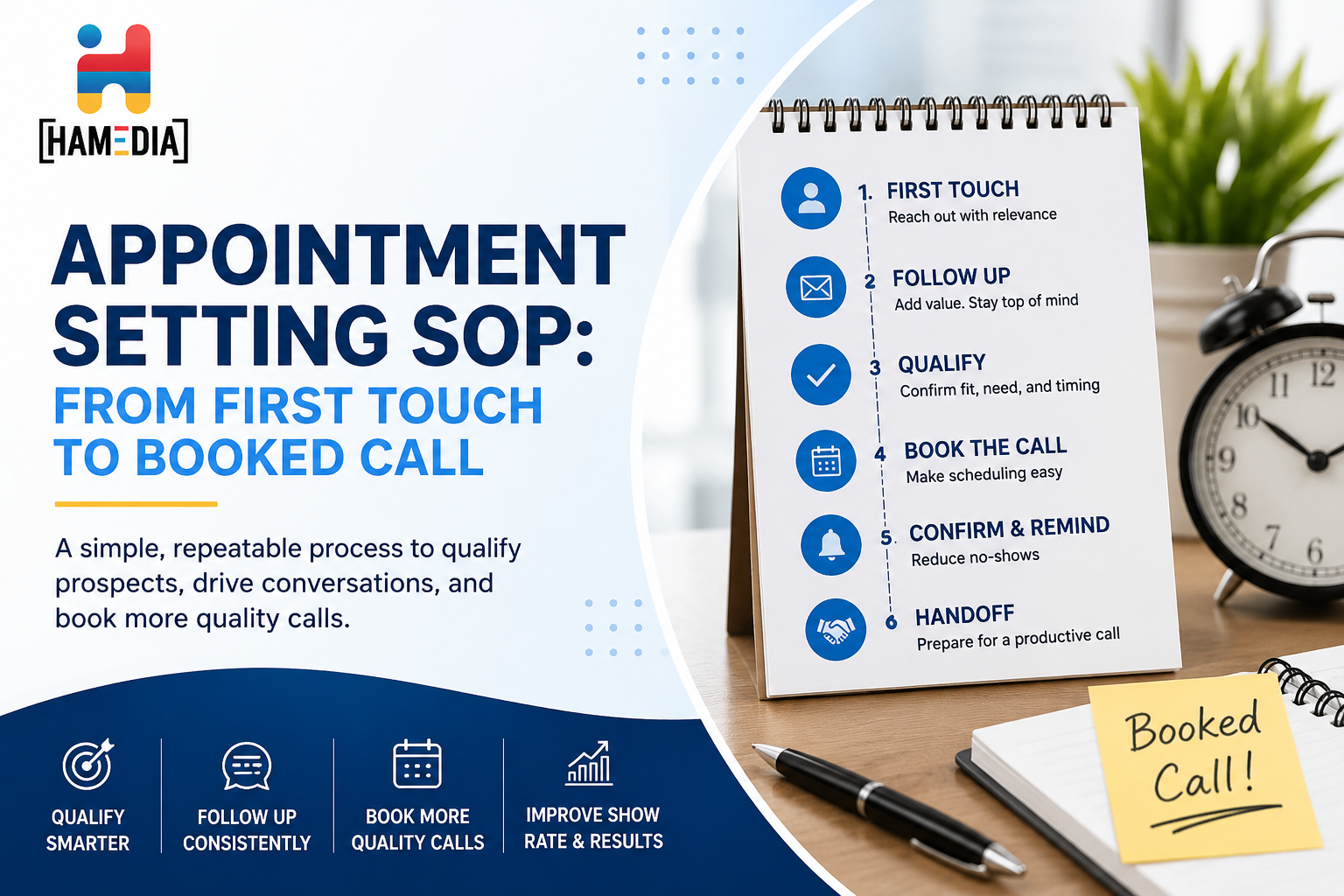
This blog breaks down a simple appointment setting SOP that helps teams move from first touch to booked call with more structure and less guesswork. It covers qualification, follow-up cadence, booking flow, confirmation, reminders, handoff, and no-show handling so businesses can improve meeting quality, protect show rates, and create a more consistent scheduling process.
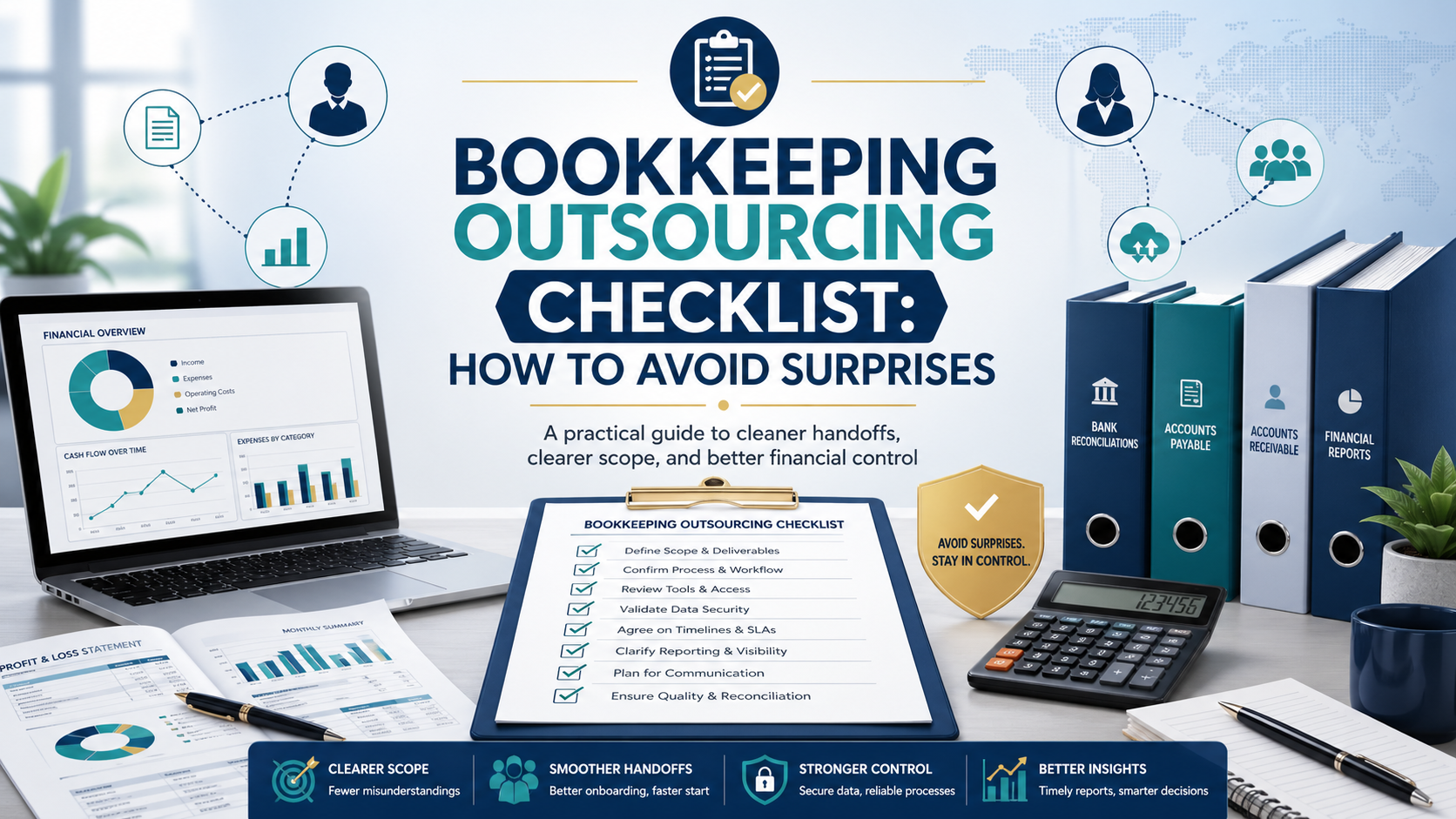
Outsourcing bookkeeping can save time and improve financial visibility, but only when the setup is clear from the start. This blog breaks down a practical checklist to help businesses avoid common surprises by defining scope, cleaning up records, setting reporting expectations, protecting access, and building stronger controls before handing the work off.
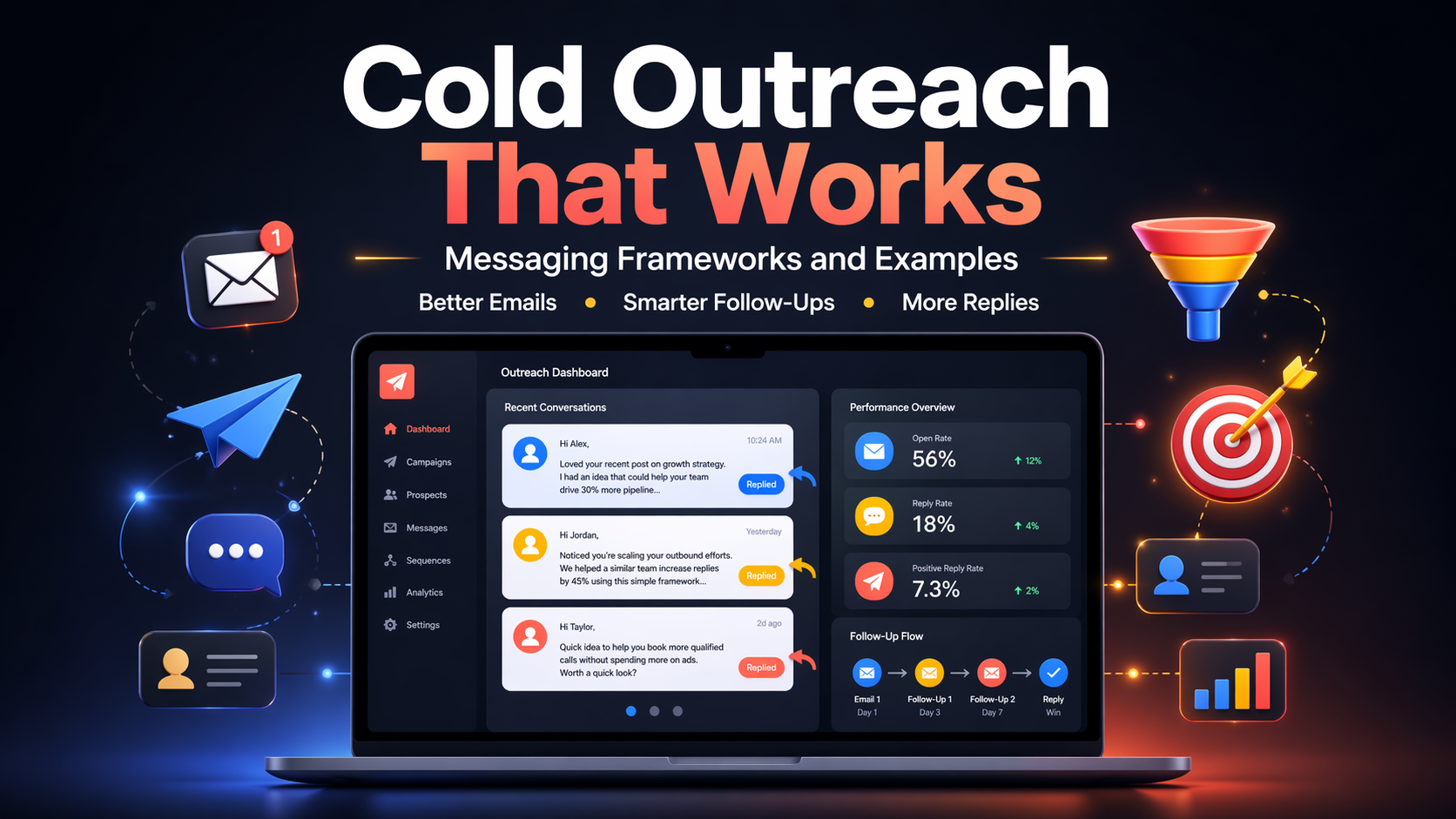
Cold outreach works best when the message feels relevant, human, and easy to respond to. This blog breaks down practical messaging frameworks, subject line ideas, follow-up strategies, and real examples that help businesses improve outreach quality, avoid generic copy, and build a more effective cold email process.