Lead generation in 2026 is not a single channel. It is a connected engine that earns trust, captures first-party data, and turns attention into conversations through clean conversion paths, consistent nurturing, and resilient measurement. This guide breaks down the eight parts of the modern engine, where AI fits, and how small businesses can build a minimum viable system that compounds over time.
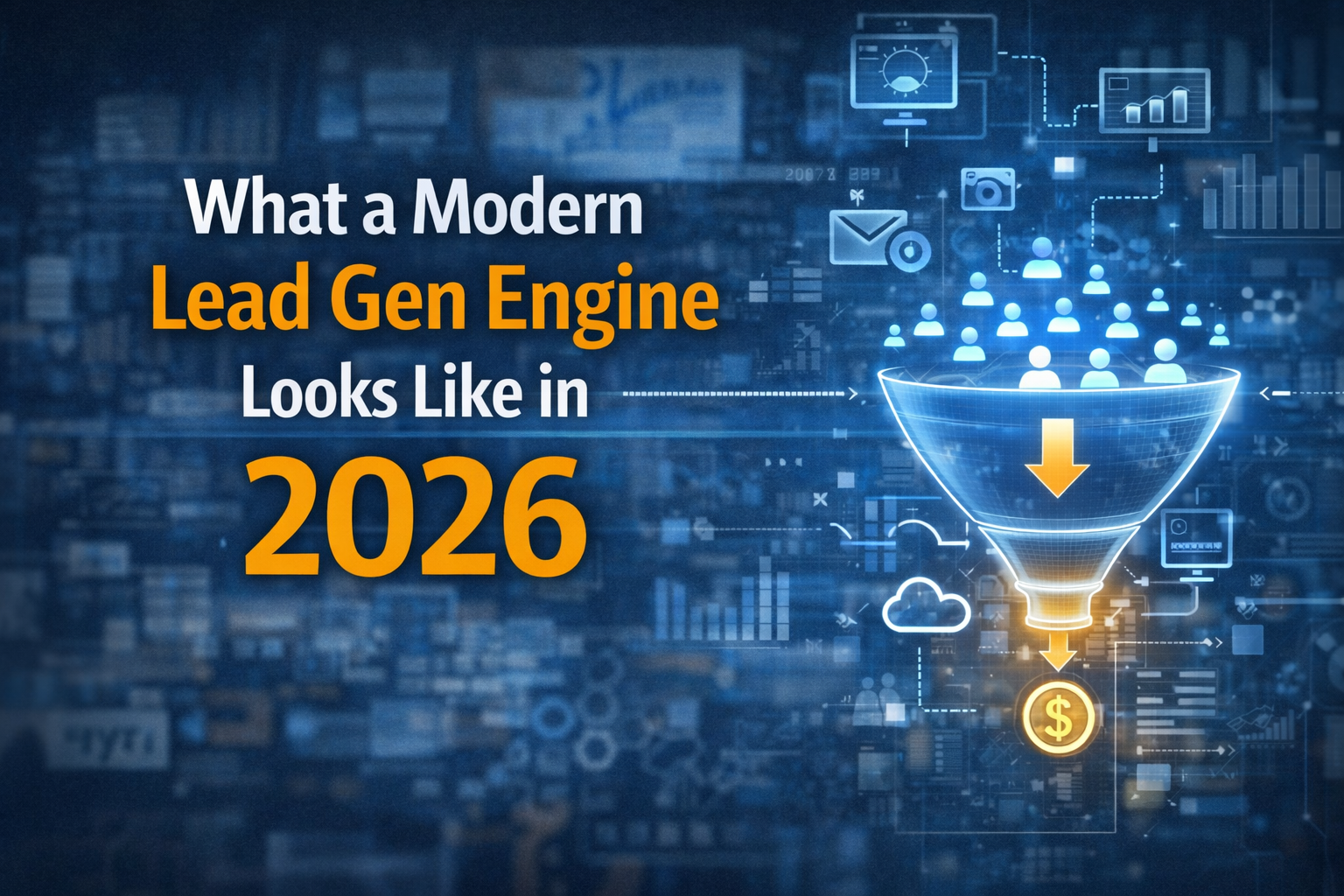
In 2026, lead generation is not a single channel or a single campaign. The companies winning are running a lead gen engine, a connected system that turns attention into conversations, and conversations into revenue, with measurement and feedback loops built in.
This matters because the old playbook is less dependable now. Tracking is not as clean as it used to be, buyers do more research before they talk to sales, and AI has raised the bar for what counts as “worth reading.” A modern engine is built to earn trust early, capture first-party data ethically, and nurture leads across multiple touchpoints without turning your team into full-time follow-up machines.
If you want a simple way to think about it, lead gen in 2026 is an operating system, not a marketing project. It is the same way you would treat finance or fulfillment: a repeatable process with ownership, standards, and weekly improvements.
A modern engine starts by accepting one reality: you do not fully control attribution anymore. Privacy changes and platform behavior mean you need a strategy that does not collapse when tracking is imperfect.
Instead of building everything around pixels, the 2026 approach builds around trust signals and owned systems: clear positioning, proof that feels real, content that answers real questions, and a clean path to capture first-party data through your forms, CRM, email list, and booked calls.
A lead gen engine is eight connected parts. When one part is weak, the system feels leaky even if you are getting traffic. Fixing one part often improves multiple metrics at once because everything connects.
Modern lead gen begins with clarity. If your offer is “we do everything,” your leads will be mixed quality and your sales cycle will stretch because people do not know if you are for them. In 2026, the strongest offers are specific: a clear outcome, for a clear customer, with a clear process.
If you provide outsourcing and automation, the promise usually performs better when it is framed as speed, consistency, and reduced overhead, not low cost labor. Buyers want reliability and control, especially when they are delegating important functions.
Buyers are more skeptical in 2026 because everyone has logos and AI-written case studies. Proof has to feel grounded and specific, like before and after metrics, short process snapshots, simple checklists, and transparent timelines.
One easy upgrade is to show how the work is done, not just what you claim. When prospects can see your process, they feel safer booking a call because the unknown gets smaller.
The highest ROI content still comes from intent-driven search. People in buying mode search for problems, comparisons, timelines, costs, and checklists. That is why modern content engines are built around decision support, not just awareness.
For outsourcing brands, this means content that answers questions like when to outsource, how to onboard remote hires, what to automate first, and how to measure performance. The post should naturally link to the service that solves the problem so readers can take the next step.
A modern engine does not pick one channel and pray. It runs a small set of channels that reinforce each other, so when one slows down the pipeline does not stop.
A stable pattern in 2026 is search content for high-intent leads, email nurturing to convert, outbound or partnerships for predictability, and retargeting that stays compliant and helpful. The key is consistency, because compounding is what makes an engine different from a campaign.
Most businesses lose leads in the middle. Someone is interested, but the next step is confusing, slow, or too demanding. In 2026, friction kills conversions fast because people have more choices and less patience.
Your conversion layer should be simple: one strong call to action, a short form, a clear scheduling path, and an immediate “what happens next” message. The goal is to remove uncertainty and reduce time to conversation.
In 2026, many leads are not ready today. They need follow-up, but they do not want spam. The modern approach is helpful touchpoints: short check-ins, value-based follow-ups, and a clear way for the lead to raise their hand when timing is right.
This is where CRM automation and consistent messaging make a big difference, because a human team can stay warm and responsive without manually chasing every lead. When done right, nurturing feels like good service, not pressure.
A lead gen engine breaks when marketing hands off maybe leads and sales complains about quality. The fix is a clear definition of qualified, plus a consistent handoff that includes context and next steps.
Pricing pages can help qualification too, as long as they answer the questions buyers have before a call: what is included, how onboarding works, and what outcomes you support. That reduces low-fit calls and improves close rates.
In 2026, measurement needs to be resilient. Instead of obsessing over perfect attribution, focus on metrics you can trust: lead-to-call rate, call-to-opportunity rate, close rate, time-to-first-response, and cost per qualified conversation.
Those metrics stay useful even when last-click tracking is incomplete, because they tell you whether the engine is healthy and where it is leaking.
AI is not the strategy. AI is the accelerator. The best use in 2026 is speeding up repetitive work while keeping human judgment in the loop, like drafting follow-ups, summarizing calls, routing inbound inquiries, and producing first drafts of content or SOPs.
Search teams have also made it clear that AI-assisted content can perform well when it is genuinely helpful and created for people, not made just to manipulate rankings. The standard is quality: accuracy, specificity, and usefulness.
If you want something realistic for a small business, build it in this order: one clear offer, one clean booking path, intent-based content, consistent follow-up, and simple measurement that guides weekly improvements. That system can compete even against bigger brands because it compounds.
If you want help turning this into a working system, your next step is to map your current funnel, find the biggest leak, and fix that first. Engines win by improving one bottleneck at a time.
A modern lead gen engine in 2026 is a connected system that earns trust, captures first-party data, and converts with consistent nurturing and clear measurement. If you build those pieces together, you get compounding results instead of random spikes.
If you want to talk through your current setup and what to fix first, start here.
Valerie Vince Cruz is a thought leader in AI-enhanced outsourcing and business operations. With years of experience helping companies scale efficiently, they share insights on the latest trends and best practices in the industry.
Get in touch with our team and we'll help you find the right solution.