
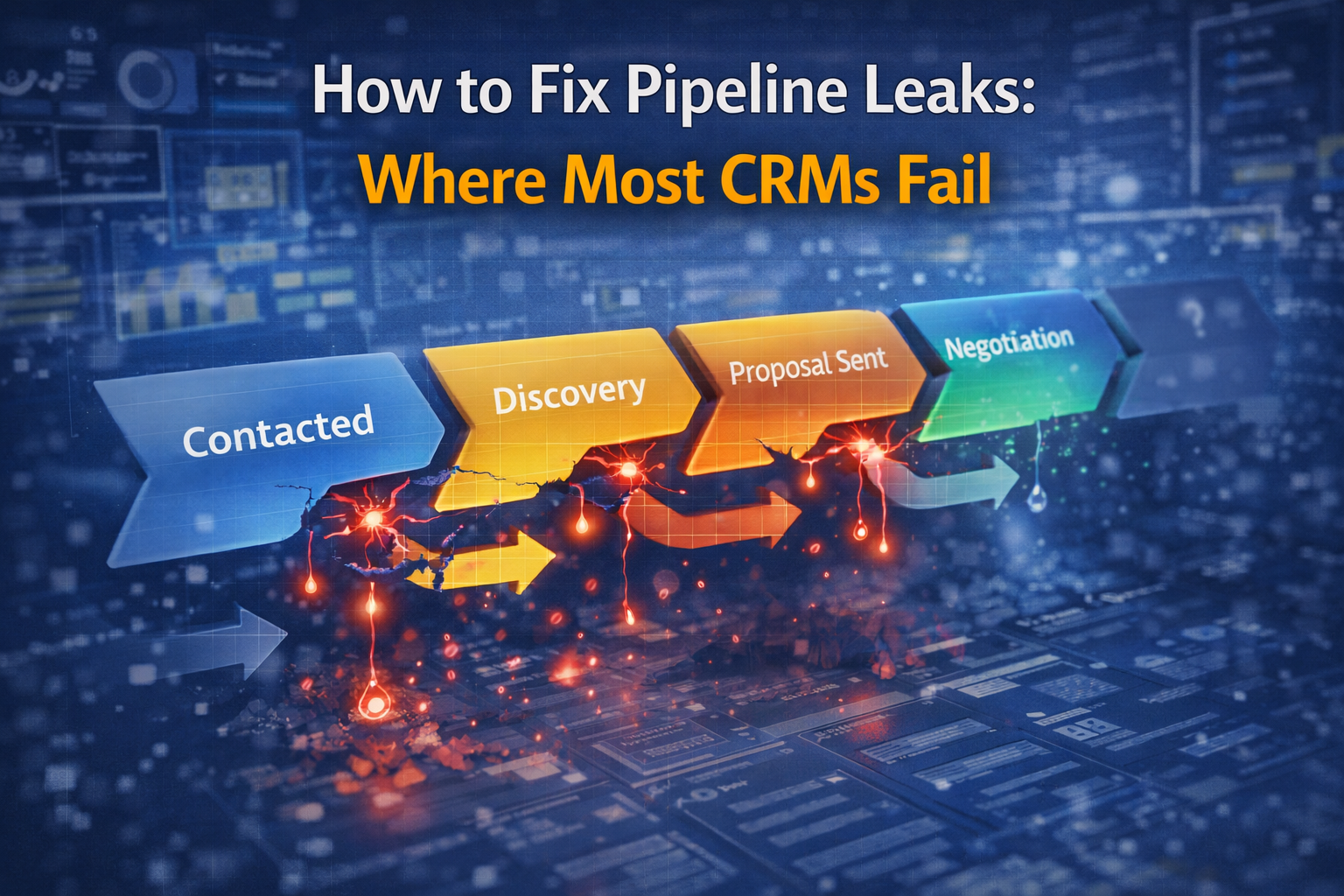
Most CRMs fail because they allow vague stages, missing next steps, messy data, and inconsistent follow-up, which creates silent pipeline leaks. This guide shows where leaks come from, how to diagnose them fast, and how to fix your CRM with clear stage rules, required fields, automation, SLAs, and simple reporting so your pipeline becomes predictable again.
A CRM is supposed to make revenue predictable, but in many startups and SMBs it becomes a messy database that nobody trusts. Leads come in, activity happens, and the team stays busy, yet deals still slip, follow-ups get missed, and management cannot tell what is real versus what is hopeful. That gap is what a pipeline leak looks like.
Pipeline leaks are not usually caused by “bad salespeople.” They are caused by a CRM that does not enforce clarity, ownership, timing, and consistency. When your pipeline stages are vague, your fields are optional, and your follow-up is manual, the system silently allows revenue to fall through cracks.
This guide breaks down where CRMs fail most often, how to spot leaks quickly, and how to fix them with simple rules and workflows that your team will actually follow.
A pipeline leak is any point where a lead that should have progressed either stalls without a next step, disappears without a clear outcome, or gets mishandled because the CRM does not force the right action at the right time. In a healthy pipeline, every open deal has an owner, a next step, and a date. In a leaky pipeline, open deals become a graveyard of “maybe later.”
Many pipelines are built around vague labels like “Contacted” or “In Progress.” The problem is that these stages do not tell your team what must happen next. Stages should be tied to buyer actions, not seller hopes.
A stronger stage definition sounds like this: “Discovery call completed” or “Proposal sent and confirmed received” or “Decision meeting scheduled.” Those stages reduce confusion and force forward motion.
If anyone can move a deal forward without meeting clear requirements, your reporting becomes meaningless. Most CRMs fail because stages do not have required criteria.
A simple fix is to define entry and exit rules for each stage. For example, a deal cannot enter “Proposal Sent” unless a proposal link is logged, and it cannot enter “Negotiation” unless the decision-maker and decision date are recorded.
The most common leak is the missing next step. When the CRM does not require a next task and due date, deals sit quietly until it is too late.
A working rule is simple: no open deal without a next step and a next step date. If there is no next step, the deal is not real, it is just a contact.
A surprising amount of pipeline leakage happens before the pipeline even begins. If inbound leads wait hours or days for a response, conversion drops and the CRM never reflects the loss because the lead simply disappears.
Fixing speed-to-lead is one of the highest ROI changes because it impacts every channel. A fast first response, even a simple acknowledgement, improves trust and keeps conversations alive long enough to qualify properly.
If a lead is not assigned to a person, it is assigned to nobody. Many CRMs fail because they allow unowned leads and deals.
This is why routing rules matter. Every lead should be auto-assigned based on region, service type, account type, or round-robin, then tracked with an SLA like “contact within 15 minutes” or “contact same business day.”
Duplicate records, missing emails, inconsistent tags, and bad phone numbers create silent failure. Your team spends time working leads that cannot be reached, or multiple reps contact the same person, which damages trust.
The fix is not to yell at the team. The fix is to make hygiene part of the workflow. Require key fields, run weekly dedupe, standardize tags, and assign someone to maintain CRM cleanliness.
Most deals are not lost because the offer was wrong. They are lost because follow-up did not happen consistently. CRMs fail when they rely on memory instead of systems
A basic fix is a standard follow-up cadence per stage. It does not need to be aggressive. It needs to be consistent, with tasks created automatically and a clear stop condition when the lead responds or books.
Some teams move deals forward to “look good” or to organize tasks. That breaks forecasting and hides leaks. Stages should represent the customer’s buying progress, not your internal workload.
If you want a true forecast, your pipeline must be honest. That means clear definitions, enforced rules, and a culture where moving a deal backward is normal when reality changes.
Many dashboards show calls made and emails sent, but ignore the metrics that reveal leaks: lead-to-appointment rate, stage conversion rates, time-in-stage, and no-next-step count.
When you track time-in-stage, leaks become obvious. A deal sitting in “Proposal Sent” for 21 days is not a pipeline asset. It is a follow-up failure or a qualification failure.
Start by pulling a list of every open deal and sorting by “last activity date.” Anything with no activity in 7 to 14 days is a leak candidate. Then check how many deals have no next step, missing decision-maker, or missing close date. Those are structural leaks.
Next, measure stage conversion rates. If many leads enter “Contacted” but few reach “Discovery Scheduled,” your leak is at speed-to-lead, messaging, or follow-up consistency. If many deals reach “Proposal Sent” but die there, your leak is in decision process, objections, or post-proposal follow-up.
Rewrite your pipeline stages so they describe customer progress, not your internal effort. This alone improves forecasting and helps reps understand what to do next.
Pick 3 to 6 required fields that make the pipeline real: decision-maker, lead source, deal value, next step, next step date, close date, and reason lost if closed-lost.
Then block stage movement when key fields are missing. Your team might resist at first, but adoption improves quickly once they see fewer dropped deals and clearer priorities.
Every stage should trigger a default task cadence. Not spam. Just a reliable system: first contact attempt, second attempt, value add follow-up, and a “close the loop” message.
A fast pipeline starts with fast response. Set a clear SLA and make the CRM show breaches. Even a basic SLA like “new lead contacted within 2 business hours” will expose leaks immediately.
A CRM stays clean only when someone owns it. That can be an ops coordinator, a VA, or a sales admin. Their job is to run weekly cleanup, dedupe, field completion checks, and dashboard health.
In week one, fix stage definitions and make next-step required. That stops the bleeding.
In week two, build basic automations for lead routing, task creation, and follow-up triggers.
In week three, clean the database, standardize tags, remove duplicates, and update old deals with clear outcomes.
In week four, implement dashboards that show pipeline health: time-in-stage, stage conversion, no-next-step count, and lead-to-appointment rate, then run a weekly pipeline review that focuses on leaks and fixes.
Most CRMs fail for simple reasons: unclear stages, optional next steps, messy data, inconsistent follow-up, and weak ownership. Fixing pipeline leaks is not about adding more tools. It is about making your CRM enforce reality so the team does the right things by default.
If you want help rebuilding your pipeline system so it runs cleanly with automation, clear SOPs, and measurable reporting, start here.
Valerie Vince Cruz is a thought leader in AI-enhanced outsourcing and business operations. With years of experience helping companies scale efficiently, they share insights on the latest trends and best practices in the industry.
Get in touch with our team and we'll help you find the right solution.