
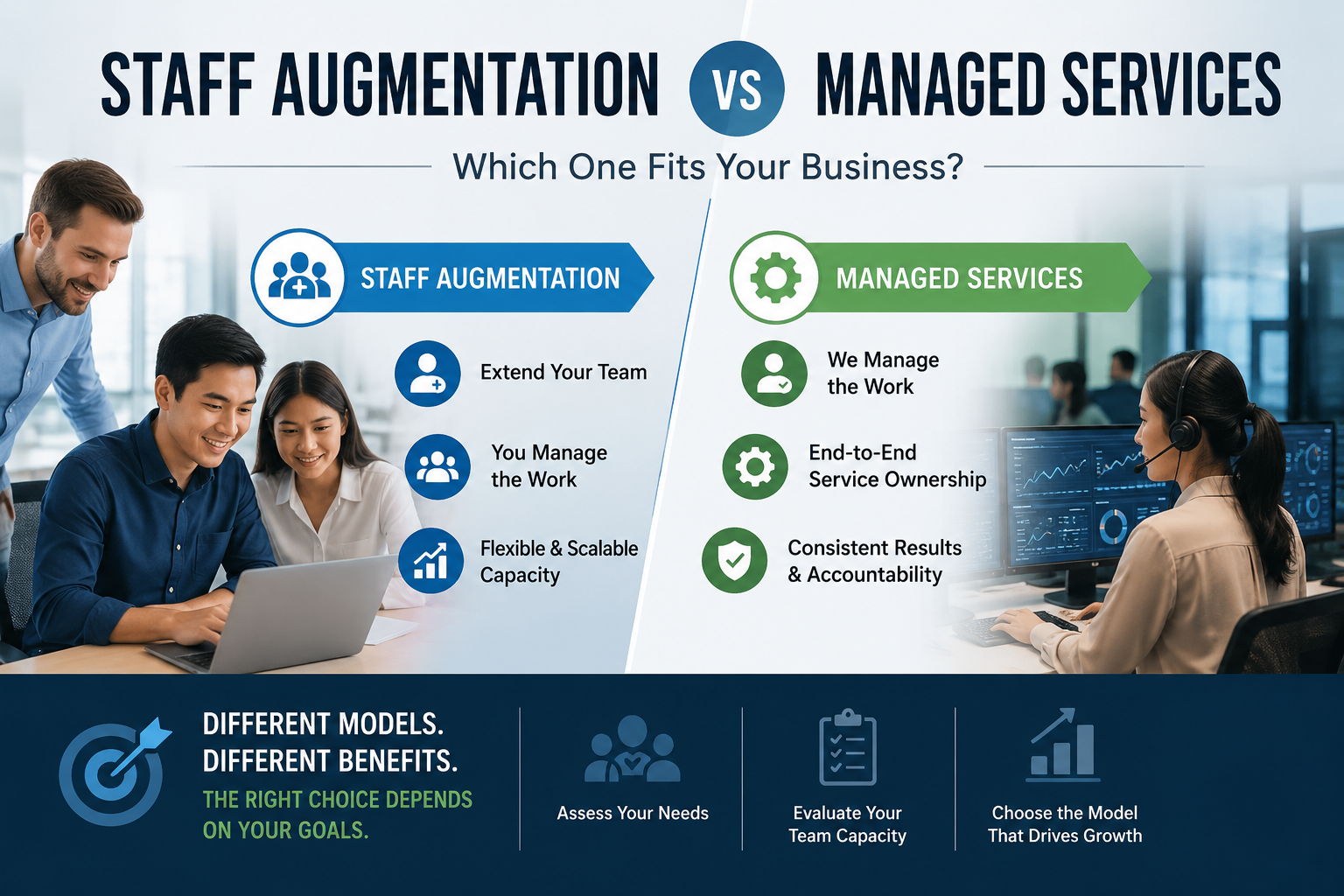
Staff augmentation and managed services can both help a growing business, but they solve different problems. This blog explains how each model works, when one makes more sense than the other, and how businesses can choose the right fit based on team capacity, process maturity, and the level of support they actually need.
A lot of businesses reach the same point at different times. The work is growing, the internal team is stretched, and something has to give. That is usually when two models come into the conversation: staff augmentation and managed services. Both can help, but they solve different problems. One adds people into your existing operation. The other gives an outside partner responsibility for a defined function or outcome. Guidance on outsourcing models consistently draws that line: staff augmentation extends your internal team, while managed services shifts delivery responsibility for a lane of work to the provider.
That difference matters because the right choice depends less on trend and more on operating reality. If your team already has a strong process and just needs extra hands or a missing skill set, staff augmentation may fit better. If your business wants less operational burden and clearer outside ownership, managed services may be the stronger option. Hamedia’s own positioning fits naturally into this conversation because its site emphasizes AI-powered operations support, trained teams, workflow management, KPI visibility, and structured service delivery rather than loose one-off help.
Staff augmentation is usually the better fit when you want outside talent to work inside your team structure. In this model, the added people use your systems, follow your processes, and work under your direction. The main advantage is flexibility. You can add capacity or a specific skill without going through the full cost and delay of permanent hiring. That is one reason staff augmentation is often used when companies need targeted support for a project, a growth period, or a short-term gap.
This model works best when your team already knows how the work should run. You have the workflow. You have the standards. You have the manager. What you need is more execution power or a missing specialist. In that case, staff augmentation can be a clean way to extend your operation without redesigning it.
Managed services are different because the provider is not just adding people. The provider is taking responsibility for a defined service lane. That usually includes the process, the staffing, the day-to-day management, and the service standards. Managed services are commonly sold on a recurring model with service expectations defined up front, which is why the model often feels more structured and outcome-based than staff augmentation.
This model tends to fit better when the business does not just need more labor. It needs the work itself to be run with more consistency, more coverage, and less internal oversight. That can be especially useful when a business wants to offload recurring operational work, reduce management load, or gain more predictable support in a defined area.
A simple way to think about it is this: with staff augmentation, you are still managing the work. With managed services, you are managing the relationship while the provider manages the work. That does not mean you lose visibility or control over outcomes. It means the operational burden shifts more heavily to the provider.
That distinction matters because some businesses think they want managed services when they really want extra hands. Others think they want staff augmentation when what they actually need is a provider to own an entire support function. Choosing the wrong model usually creates frustration because the structure does not match the real need.
Staff augmentation usually makes more sense when you already have a strong internal manager and a stable workflow, but you need to add capacity quickly. It is also a good fit when the skill gap is specific and targeted. For example, you may need additional support for a rollout, a short-term project, a backlog, or a highly specialized function that your internal team cannot fully cover right now.
It also fits businesses that want to keep direct control over tools, training, priorities, and day-to-day decision-making. In that setup, the outside person or team becomes part of your operating rhythm rather than a separate managed function.
If your business needs that kind of support around recurring admin work, CRM updates, inbox handling, scheduling, reporting, and operational execution, this is a natural place to point readers toward Hamedia’s virtual assistant services. If you need reliable support that plugs into your existing workflow and helps your team move faster, check this page.
Managed services usually fits better when you want an outside provider to run a defined service lane with less internal supervision. This is especially helpful when the work is recurring, process-driven, and operationally heavy. In those cases, the provider’s value is not just extra people. It is the fact that they bring a full delivery model, service structure, and recurring accountability.
This model is also often stronger when your internal team is already overloaded with management work. If every new person still needs heavy supervision from your side, augmentation may not actually reduce pressure. Managed services can be the better choice when the business wants clearer service ownership, broader coverage, and a more repeatable support layer.
This is also where https://www.hamediaagency.com/ becomes relevant. The homepage highlights AI-powered operations support, operational support staff, KPI tracking, workflow management, and 24/7 support. That kind of positioning fits businesses that are not just looking for one more person, but for a more structured outside support model.
One common mistake is choosing staff augmentation when the real problem is weak internal management. If your process is unclear, your ownership is vague, and your team does not have time to train or direct the added people, more bodies will not solve the core issue. The added capacity may even create more confusion.
Another common mistake is choosing managed services when the business still wants to control every tiny step. Managed services works best when the provider has room to actually manage the service lane. If the client wants full outside ownership but also wants to direct every daily action like internal staff, the model becomes harder to run well.
In practice, some businesses land somewhere in the middle. They may keep internal leadership and strategy, use staff augmentation for one skill gap, and use managed services for another recurring function. That kind of hybrid approach is common when companies want to keep control over core decision-making while still reducing pressure in day-to-day operations.
That is often the most realistic answer for growing businesses. Not every function needs the same support model. Some areas need embedded talent. Other areas need a provider to fully own delivery. The right fit usually comes from looking at management load, process maturity, and how much operational responsibility your internal team can actually carry.
A useful way to choose is to ask a few direct questions. Do you already have a manager and process ready for added people? Do you mainly need skill coverage or capacity? Do you want to keep direct control over the work every day? If yes, staff augmentation may fit better.
On the other hand, ask whether you want a provider to own a defined lane, whether your team is overloaded with supervision already, and whether the work would benefit from service levels, recurring accountability, and more structured delivery. If yes, managed services may be the stronger fit.
If your team is trying to figure out that line in a practical way, Hamedia’s approach page is a strong intern
al destination because it frames support around goals, workflows, reporting, escalation, and fit rather than only around headcount.
Staff augmentation and managed services can both work very well, but they are not interchangeable. Staff augmentation is usually best when you want outside people working inside your team under your direction. Managed services is usually best when you want an outside provider to take responsibility for a defined service lane. The better model is the one that fits your management capacity, process maturity, and operational goals.
Val Vince is a thought leader in AI-enhanced outsourcing and business operations. With years of experience helping companies scale efficiently, they share insights on the latest trends and best practices in the industry.
Get in touch with our team and we'll help you find the right solution.